
Peak Hunt Challenges
Collect peaks and distinctive waypoints by air and on foot, earn points and bonus points, and climb the leaderboard.
Rules and scoring
Peaks
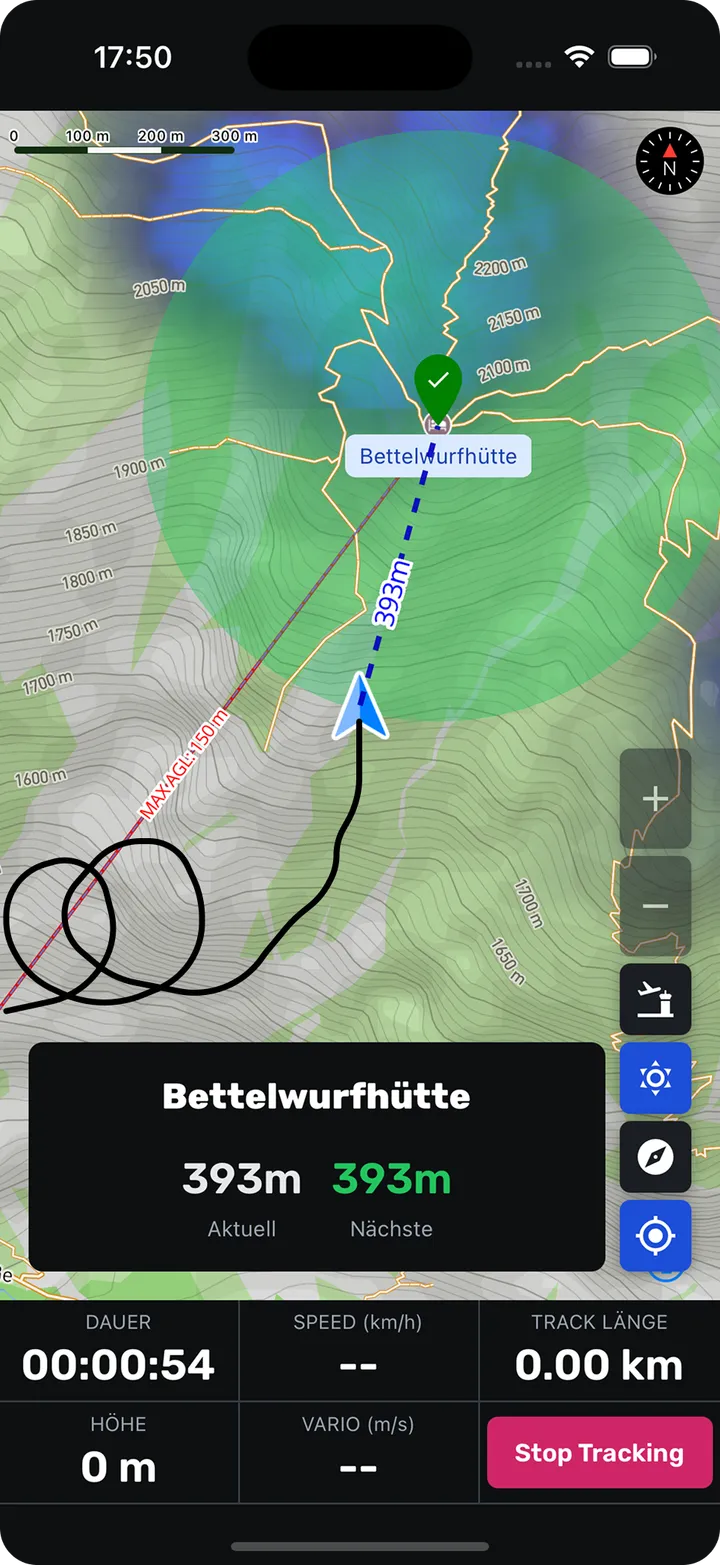
Each peak (waypoint) has coordinates, a radius and a type. To mark a peak, the flight or hike track must cross the radius.
3 peak types
- Hike & Fly (default) — Can be marked on foot or in the air
- Fly only (paraglider icon) — Can only be marked in flight. The system checks that the pilot never stays below 10 km/h for more than 20 seconds inside the radius
- Hike only (hiker icon) — Can only be marked on foot. The system checks that the pilot stays below 10 km/h for 20 seconds inside the radius
☝️ A peak does not have to be a summit — it can be another highlight, such as a lake, a station or a mountain hut.
Scoring
Example points from the Pinzgau Challenge
Each peak has a difficulty: "Easy", "Medium", "Hard", "Very hard"
Each peak has a predefined radius between 50 m and 1,500 m. If the flight or hike track touches the radius, you get the points.
Points depend on difficulty:
- Easy: 8 pts (blue)
- Medium: 10 points (red)
- Hard: 12 points (black)
- Very hard: 14 points (black with yellow type)
You only get the peak points once per challenge.
On top: per flight, per calendar day, you get 0.5 points for a flight that touches at least one peak (whether or not that peak was already collected)
Bonus points from "Proximity"
The simple version: the closer you fly to the centre, the more bonus points you get (maximum 2 pts).
The exact definition: each peak has a predefined radius. Entering that radius awards all points for the peak. Pilots can earn up to 2 extra bonus points by getting closer to the centre. Bonus rises linearly from 0 at the edge of the radius to 2 for flying exactly over the coordinates. Bonus is rounded to two decimals. You can improve bonus on a later flight. If you are there on foot (launch or walk through), you automatically get the 2 bonus points.
☝️ Flying close to terrain is dangerous — we all know that. Near summits you often get turbulence. Better to climb out high or try another day with better conditions. The bonus points will still be there :-).
Bonus points from a "Peak series"
The simple version: the more peaks you collect on one calendar day, the better for your ranking.
The calculation: from the second peak on a calendar day (in one or several flights) you get 0.5 bonus points per extra peak. That also applies to peaks you already collected on other days.
Formula: (number of peaks − 1) × 0.5
Example: 6 peaks = (6 − 1) × 0.5 = 2.5 points
An example
Hike&Fly with 3 peaks (black flying, pink on foot)
- Flight: 0.5 points because the flight touches at least one peak
- Peak-series bonus: 1 bonus point for the series (2 extra peaks)
- Total: 0.5 (flight) + 9.98 + 12 + 11.93 (peaks) + 1 (series) = 35.41 pts
How to take part
- Download the Sidekik app. Sidekik is on Android and iOS in the stores.
- Join a challenge. Read the rules and terms, then join the challenge.
- Export the waypoints to your GPS / flight app, or track the flight or H&F directly in Sidekik
- Enjoy the adventure. Collect points by reaching peaks in the air or on foot — depending on how each waypoint is defined.
- Save or upload the flight. If you tracked with Sidekik, save it online. You can also upload an .igc or .gpx file and share it with friends.
- Check the scoring and climb the leaderboard. Your flight is analysed automatically. See which peaks you marked and how many points you scored. Your rank shows on the leaderboard.
General rules
- All flights uploaded in the defined window count. Flights must be submitted by 23:59 on the end date at the latest.
- Flights must be submitted within 2 weeks to count for scoring.
- You can register and join at any time before or during the challenge window.
- In some challenges you may only launch from predefined take-offs.
- You may land anywhere.
- Flights that break air-traffic law are disqualified (the system does not check this).
Safety and liability
Do not fly too close to terrain when crossing a summit. Always keep a safe distance from the ground.
Be careful with strong thermals and turbulence near peaks. If conditions are dangerous, do not try to mark the summit. You can try another day and still get full points.
Weather: always check conditions before flying and do not fly when it is unsafe.
Respect airspace and hunting no-fly zones.
Every pilot is responsible for themselves and needs a valid licence. The platform operator does not check this.
Start your adventure!
Download the free Sidekik app